

Views: 418
(Updated article in 2025 To include practical examples and insights on the role of the deliver in the measurement of physical advancement, in the definition of the contractual milestone and in the formal approval processes.)
Inside the concept of deliverable
In the process of Scope Management, one of the most critical aspects concerns the identification of deliverable and the definition of clear criteria for their approval. This article focuses precisely on the nature of the deliverable, on their function in complex projects and implications for the control of advancement and contractual milestone.
Cosa significa deliverable in project management?
He finishes deliverable is often translated with "expected result" or "delivery product". However, None of these Italian expressions can fully express the operational value of the term in the management practice of projects.
In general, con deliverable We mean a product tangible, specific and measurable to be delivered during the execution of the project. It is an element that represents an intermediate or final output output, whose availability allows to certify the actual progress of the activity or the design phase to which it is associated.
Examples of deliverable
A (o o) deliverable is usually made up of a package of documents: drawings, technical specifications or finished products, like a prototype, a mathematical model, the result of a geological or market survey, the completion of a preliminary design, the arrival of complex equipment on site, such as the launching equipment for the beams, ecc.
The importance of identification in the planning phase
Ideally, theDELIVERABLE PROJECT should already be identified in the planning phase (project planning). In the most structured contexts, The list of deliverables is the subject of formal validation between the parties and is often linked to the release of payment installments or to the activation of subsequent stages of the contract.
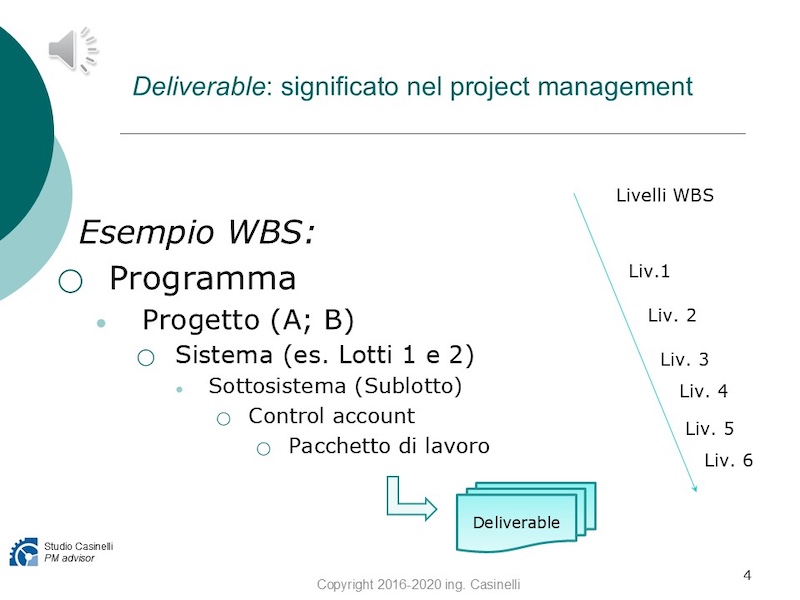
Generally, Each deliverable is the subject of a submission procedure (submittal), Revision and acceptance by the customer, according to contractually defined methods.
Their identification is carried out during the phase of analysis and definition of the purpose of the work (Scope Management). In general, this implies a formal issue and delivery (submittal) to the client; In more complex cases, delivery can be made for intermediate steps and followed by a workshop.
Basically, the Management of a deliverable it should always be a formalized process, default, what a rule – contractually – the submission to the customer, any reviews and additions, and final acceptance.
Role of the deliver in the measurement of advancement
One of the most relevant operational uses of the deliverable is their correlation with the measurement of physical advancement of the project (progress measurement). In particular:
- Each deliver can be associated with a conventional weight in the advancement system;
- The completion and acceptance of a deliverable objectively attest to the percentage made;
- The set of deliverable represents a tangible reference for the validation of the progress (SAL).
This logic is particularly useful in progressive paid projects (milestone-based) or when physical control is more relevant than financial control.
Deliverable and contractual milestone
In many contracts, Some deliverables are associated with intermediate milestones, which mark fundamental stages in the advancement of the project. Failure to achieve Milestone can entail:
- delays in the decision -making chain or supply;
- Activation of contractual penalties;
- Revision of the Payment Plan.
For this reason, It is essential that the Milestone based on the deliverable are clearly included in the project program, integrating the technical and contractual components. This use allows the definition one road-map calendarized of the execution of the project, identifying significant intermediate steps or results; This contributes to mitigating the risk of delays. Failure to achieve these Milestone can lead to criminal, making the inclusion of all the Milestone in the project program fundamental.
In summary, il concept of deliverable is associated with some important elements:
- Definition of the purpose (scope) of work;
- Acceptance criteria of deliverals that require a well -defined submission process, Revision and approval;
- Intermediate milestone with any penalties that are included in the program(the piano) of Project;
- Mechanism of measurement of the progress of the project(project progress), which can be based on the conventional weight of the deliverable.
Formalized management of the deliverable
The correct management of deliverable requires a formalized process that includes:
- Punctual definition: What must be delivered, with what content and in what format.
- Submission methods: channels, timing and approval levels.
- Acceptance criteria: Reference baseline, Quality standards, Approval of the required.
- Traceability system: evidence of emission, revisions, comments, approvals, waste and integration requests.
Conclusions
The concept of deliverable It is closely linked to:
- the Definition of the Scope of Work;
- the measurement of physical advancement;
- the Management of contractual milestone;
- il progressive payment system;
- and the Technical acceptance documentation.
Managing deliver in a structured way means reducing ambiguity, improve the traceability of activities and make communication between customer more transparent, project team and suppliers.
Watch the video
Acquire fundamental skills
In the management of projects!